
Mempool Congestion: Reading It Before You Send
Congestion is not a fee problem, it is a capacity problem: the network accepts 144 blocks a day and every block holds a fixed amount of transaction weight, so when more weight is waiting than fits, the only thing that clears the backlog is time, money, or priority access. Read the mempool before you send and the arithmetic is simple — a 0.3 KB transaction at a fee rate of 0.0001 BTC/KB carries 0.00003 BTC of fee, about $2.54 at $84,692 per BTC. Send during a spike and the same transaction can sit unconfirmed for days while a cheaper one submitted at the right moment confirms first.

Key takeaways
- Two numbers decide confirmation: the fee rate in BTC per kilobyte and the weight of transactions already waiting ahead of yours.
- Free acceleration is conditional, not universal: the transaction must be 0.5 KB or smaller and pay at least 0.0001 BTC/KB, with the free quota refreshed hourly and processed in submission order.
- Size costs money at a constant rate: 0.3 KB at 0.0001 BTC/KB is $2.54, while 0.7 KB at 0.0004 BTC/KB is $23.71 and cannot enter the free tier at all.
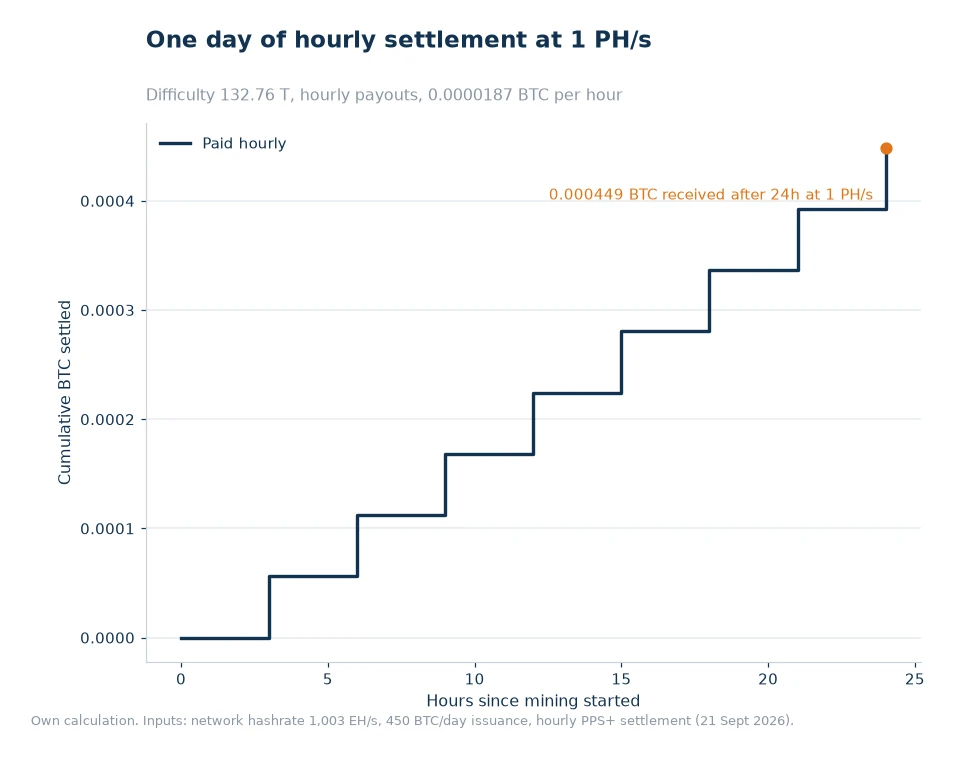
- Hourly settlement puts spendable balance in the account every hour — about 0.0000187 BTC per hour at 1 PH/s — which is what makes a paid route practical at all.
Definitions first
The mempool is the set of valid transactions that nodes know about but that no block has included yet. Congestion is the ratio between the weight sitting in that set and the weight the next block can hold. Since the protocol targets ten minutes per block and 144 blocks per day, throughput is fixed; a surge in demand shows up as a queue, not as faster blocks.
Fee rate is the price you offer for a slice of that fixed capacity, expressed in BTC per kilobyte of transaction size. It is worth stating plainly because it is where most confusion starts: the rate and the total fee are different numbers, and both matter. A small transaction at a low rate can still pay more in absolute terms than a large transaction at a lower one, while a large transaction at a high rate still fails a size cap.
Priority access is the third lever, and it has its own rulebook. A submission enters the pool's queue for the next block it mines, which is a smaller and more predictable pool of capacity than the open network — the practical difference between waiting on the mempool and buying a place in a queue that a specific operator controls.
The trade-off nobody prices
Miners tend to price waiting as free, because the coins are still yours and nothing is lost on paper. The cost is real anyway. A payout that has not confirmed cannot be posted as collateral, cannot be sold against a falling market, and cannot pay an invoice. For an operator running on thin margins, an unconfirmed chain of transactions is a liquidity problem dressed as a technical one.
Acceleration has a price list instead, and the thresholds are public: transactions up to 0.5 KB with a fee rate of at least 0.0001 BTC/KB qualify for the free quota, which refreshes hourly and is handed out in submission order; anything outside those bounds needs the paid path, settled in BTC, BCH or LTC from the account balance.[1]
What that means in practice is that a wallet's own defaults can disqualify you before you have a chance to pay. A transaction at 0.00008 BTC/KB looks unremarkable and is still below the floor. A consolidation that quietly crosses 0.5 KB is ineligible no matter how generous the fee. Checking both numbers before broadcasting is cheaper than discovering them after.
| Transaction | Fee rate | Total fee | USD | Free tier |
|---|---|---|---|---|
| 0.3 KB | 0.0001 BTC/KB | 0.00003 BTC | $2.54 | Eligible |
| 0.4 KB | 0.0001 BTC/KB | 0.00004 BTC | $3.39 | Eligible |
| 0.5 KB | 0.0001 BTC/KB | 0.00005 BTC | $4.23 | Eligible, at the size cap |
| 0.5 KB | 0.00008 BTC/KB | 0.00004 BTC | $3.39 | Not eligible — rate below floor |
| 0.7 KB | 0.0004 BTC/KB | 0.00028 BTC | $23.71 | Not eligible — over the cap |
Pay attention to rows four and five. The first is a perfectly well-funded transaction that simply does not qualify, and the second pays more than five times the fee of a qualifying transaction and is still refused on size. Eligibility is a pair of conditions, not a single price.
Example with two setups
Setup A: one clean withdrawal. A miner withdraws a single payment with confirmed inputs, producing a 0.3 KB transaction at 0.0001 BTC/KB. The fee is 0.00003 BTC, about $2.54, and the submission is eligible for the free quota. Nothing is stuck; the transaction is simply queued ahead of lower-fee weight.
Setup B: a consolidation that went wrong. The same operator sweeps a dozen small outputs into one withdrawal, which makes a 0.5 KB transaction at 0.00008 BTC/KB. The fee is 0.00004 BTC — more absolute money than Setup A — but the rate misses the 0.0001 BTC/KB floor, so the free path is closed. Reaching the floor needs 0.5 × 0.0001 = 0.00005 BTC, an extra 0.00001 BTC, or $0.85. That $0.85 is the entire difference between a transaction that waits and one that is queued for the next block the pool mines.
Set that against the income side and the scale becomes obvious. A 1 PH/s miner settles roughly 0.0000187 BTC per hour, or about $1.58, and 0.0002244 BTC over twelve hours. One hour of output finishes the Setup B fee with room to spare — which is the argument for keeping a working balance in the account rather than sweeping everything to cold storage the moment it lands. The pool's listed fees are separate from this and apply to settled income: 4% on the PPS-settled block-reward component and 2% on the PPLNS-distributed components.[2]
Where the transaction sits at the head of an unconfirmed chain, there is one more rule to respect: an input that is not yet confirmed cannot be accelerated, so the parent goes first. Working through the parent is what the ViaBTC TX Accelerator is built for, and it explains why the submission form rejects a child rather than charging for it.
Practical next steps
- Check the rate before the broadcast. If your wallet defaults below 0.0001 BTC/KB, raise it in the wallet rather than in a rescue attempt later.
- Keep consolidations out of the queue. Sweeping many small outputs creates the large transactions that fail the size cap. Do it when the mempool is quiet.
- Watch your worker hashrate against the network, not the calendar. A dip in per-worker hashrate reduces the balance you have available for fees; a mining pool dashboard shows that within minutes.
- Hold a small working balance. At 1 PH/s hourly settlement delivers about $1.58 per hour, which covers the cheap end of the fee table in a single settlement cycle.
- Size your next move with real numbers. A profit calculator that takes coin price, difficulty, fee rate and effective hashrate turns the question "can I afford this fee" into a line item instead of a guess.
Frequently asked questions
Do mining pools cost anything to join?
Joining is free; the pool earns from its fee on settled payouts, which appears as a percentage of the block-reward and transaction-fee components.
Can I mine more than one coin at the same time?
Yes. Merged mining lets a machine secure a parent chain and an auxiliary chain together, and multi-coin pools support switching between chains without moving hardware.
Does a low fee always mean a long wait?
No. Fee pressure tracks congestion, which is cyclical: a rate that sits unconfirmed for a day during a spike can clear in the next block during a quiet window. The thresholds for priority access, by contrast, are fixed and can be checked in advance.
Read the queue, then send
Congestion is one of the few variables in mining that an operator can measure before it costs anything. Check two numbers — size against the 0.5 KB cap, rate against the 0.0001 BTC/KB floor — and you know in advance whether a transaction qualifies for the free quota or needs the paid route. Keep one settlement cycle of balance on hand and consolidation stops being an emergency. The mempool will always surge; what changes is whether you find out before or after you broadcast.
Data and sources: ViaBTC transaction accelerator documentation for the eligibility thresholds[1] and the published fee schedule for listed fees[2]. Network difficulty (132.76 T), the 144-blocks-per-day target and the BTC price of $84,692 were read on 21 September 2026. Transaction sizes in the table are illustrative; figures are rounded and move with mempool conditions, difficulty and price.