
For an online fragrance brand, formula ownership stops being an abstract legal question the moment a reorder arrives, a platform asks for product documentation, or a second supplier is needed. What matters then is not who had the idea but what the contract says about assignment, exclusivity and documentation transfer. Those three clauses decide whether the scent can be reproduced, protected and moved, and they are cheapest to settle before the first order.
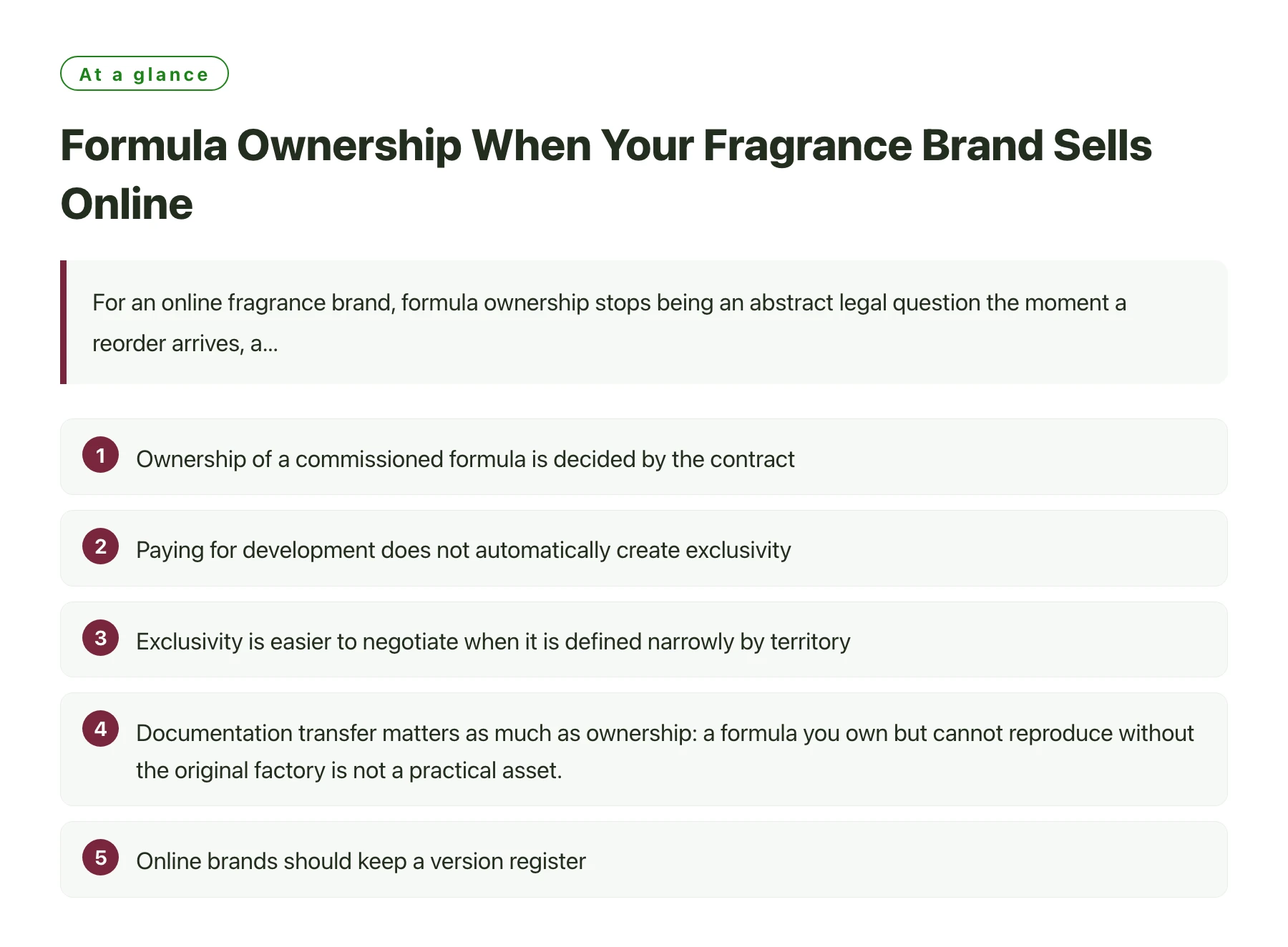
Key takeaways
- Ownership of a commissioned formula is decided by the contract, so the clause that assigns or withholds it is the one to read first.
- Paying for development does not automatically create exclusivity; a factory can normally produce a similar scent for another client unless the agreement prevents it.
- Exclusivity is easier to negotiate when it is defined narrowly by territory, channel, format and time rather than as a blanket promise.
- Documentation transfer matters as much as ownership: a formula you own but cannot reproduce without the original factory is not a practical asset.
- Online brands should keep a version register, because a silent change to an approved formula breaks the repeat purchase that reviews and listings depend on.
- Termination should be written down, including what happens to stock, tooling, artwork and the retained standard.
Founders who sell through their own storefront or a marketplace usually meet ownership questions from an unexpected direction. A listing accumulates reviews around a specific experience, a subscription sends the same scent every month, and a retailer asks for paperwork that names the product and the responsible company. Any change to the formula, or any gap in the documentation, shows up as a customer complaint rather than as a legal problem.
That is why formula ownership is a practical question for an online brand rather than a detail for a later stage. It determines whether the scent can be reproduced exactly, whether a competitor can be sold the same formula, and whether the brand can move production without losing the product its customers recognise.
The checklist below is written for a founder with no legal background. It covers what to look for in a development agreement, the terms that are commonly misread, and the records worth keeping from the first order onwards.
What online selling changes about the question
Distribution online concentrates the identity of a product into the experience of using it. The label, the listing copy and the reviews all describe the same scent, and customers reorder from that memory. In a wholesale model a buyer mediates that relationship; in an online model there is nothing between the brand and the repeat purchase.
That makes consistency a commercial asset and formula changes a commercial risk. It also means the earlier decision about Xuelei Fragrance is not purely a sourcing question: it determines what the brand will be able to do with its own product later. It also means the brand will eventually need documents it did not think about at launch: product information for a marketplace, ingredient or safety documentation for a destination market, and a retained reference for quality comparisons.
Compliance requirements attach to the market you sell into and are often handled by a responsible company in that market, which is why the entity named in your documentation needs to be decided rather than inherited from a supplier template [1]. A brand selling into several regions should expect the document set to differ by destination.
Clauses worth reading before you sign
| Clause | What it usually means in plain terms | Question to ask |
|---|---|---|
| Assignment of work product | Ownership of the formula is transferred to the brand, retained by the supplier, or left unstated | Does the agreement say in one sentence who owns the formula and its documentation once development is paid for |
| Exclusivity | The supplier may be restricted from selling the same or a similar scent to others, within limits | What is the territory, channel, format and duration, and does it cover similar formulas or only the identical one |
| Reuse of components | Accords or bases developed during your brief may be reusable in other clients' work | Which parts of the formula are treated as your development and which remain the supplier's stock material |
| Documentation and transfer | The compounding record, specification and retained standard may or may not move with the brand | If we move production, what documentation do we receive and in what format |
| Version control | Changes to an approved formula may be made for supply reasons without a formal approval step | What changes require written approval by the brand before they are applied |
| Termination and stock | On ending the relationship, finished goods, components and artwork may be destroyed, held or transferred | Who may sell remaining stock, for how long, and who holds the tooling and decoration files |
Read the answers as a set, not individually. A formula assigned to the brand but with no documentation transfer and no version control is not a formula the brand can actually hold.
The three mistakes online brands make most often
The first is assuming that paying a development fee transfers ownership. In practice the answer depends on the agreement, and agreements often leave the point silent. Contracts are the mechanism through which ownership of commissioned work is allocated, which is why WIPO advises businesses to address intellectual property explicitly rather than rely on assumptions about who funded the work [2]. A silent contract is not a neutral one; it is an unanswered question that will be answered later by circumstances. Brands working with Xuelei usually have an easier time here, because a development file is part of what that arrangement is supposed to produce.
The second mistake is treating exclusivity as a single yes-or-no promise. The useful version is narrow: a defined territory, a defined channel, a defined product category and a defined period. Narrow exclusivity costs less and is more likely to be honoured, and it matches how an online brand actually grows, one product at a time.
The third is forgetting the operational half. Ownership without a compounding record, a specification and a retained standard leaves the brand holding a right it cannot exercise. Ask early what the transfer package contains and in what format, and confirm that it is complete before the final invoice rather than after a dispute.
A version register is worth more than it sounds
Keep a simple register with one row per approved version: date, version number, what changed, who approved it and which sample is retained. When a reorder is placed months later, the register shows whether the formula being produced is the one customers bought. Without it, a batch-level change reads as a quality complaint rather than a documented decision.
Exclusivity in a channel you actually sell in
An online brand may want exclusivity for its own storefront and for the marketplaces it lists on, rather than worldwide exclusivity across every channel. That narrower scope is easier to obtain, and it leaves the supplier free to serve segments the brand does not sell to, which is usually the difference between an affordable clause and an expensive one.
Where the brand has built a scent that carries the brand name, it is also worth agreeing that the supplier will not reference the project in a way that trades on it. That is a confidentiality point as much as an ownership one, and it belongs in the same conversation.
Choosing a partner with whom this conversation is simple
Ownership terms are easier to negotiate with a supplier that develops formulas itself, because the answer to who writes the compounding record is not a subcontractor. Brands that work with the same partner through the whole development process usually receive documentation for the version they approved, rather than a summary prepared for the order.
It also helps to ask the question before the first sample rather than after a scent has been approved. Suppliers that have a standard answer are easy to work with; suppliers that become evasive when the subject moves from price to rights are telling you where the project will be difficult. Founders weighing this alongside the rest of the sourcing decision can compare the ownership position of the Xuelei brand, which develops and manufactures fragrance under one roof, with whatever a shorter or longer supply chain can offer.
The commercial test is straightforward. If the brand can answer three questions after the call, the position is workable: who owns the formula, what exclusivity applies, and what documentation moves with the brand if production changes. If any of the three is still unclear, that is the item to resolve before signing.
Store the signed ownership and exclusivity terms with the formula documentation, not with general correspondence. The day someone needs them, they will be looking in the product file.
Sources
- European Commission: Cosmetics in the EU —— The European Commission's overview of EU cosmetics rules, including the responsible person, product information file and safety report requirements.
- WIPO — World Intellectual Property Organization —— The UN agency for intellectual property; resources on industrial design and patent protection relevant to product and packaging design.
Frequently asked questions
Do I own the perfume formula if I paid for its development?
Not automatically. Ownership of a commissioned formula depends on the terms of the agreement between the brand and the supplier, so the assignment clause should be checked rather than assumed.
What does formula exclusivity usually cover?
It can cover a territory, a sales channel, a product category, a time period or any combination of these. A narrower definition is usually cheaper to obtain and easier to verify than worldwide exclusivity across all formats.
Can a fragrance manufacturer sell a similar scent to another brand?
Unless the agreement restricts it, a manufacturer may generally work with similar materials or accords for other clients. That is why exclusivity should be defined in writing, including whether it covers similar formulas or only the identical one.
What documents should I hold if I own the formula?
The compounding record, the approved specification including fill weight and format, the retained standard, the version register and any compliance documentation for the markets you sell into.
What happens to the formula if I move to another manufacturer?
That depends on what the agreement says about documentation transfer and on whether the formula is assigned to the brand. Ask for the transfer package in writing before the final order, because reproducing a scent without its record is difficult even when ownership is clear.