
 Quality and consistency are key to winning the high-end market. Vertical hydroponics operates in a sterile or low-bacteria environment, reducing pesticide use by over 90%. The risk of microbial contamination in the produced crops is extremely low, meeting increasingly stringent food safety standards, such as China's GAP certification. The nutritional content of crops, such as vitamin C and antioxidants, can be targeted to increase by 15%-30% through spectral modulation. Consumers are willing to pay a premium of up to 200%-300% of the average market price for such clean, safe, and nutritionally controlled products. Referring to the success of the American company Plenty, its indoor vertical farm-produced vegetables, with their superior appearance and "extreme freshness" concept, have become favorites in high-end retail channels such as Whole Foods Market.
The value of vertical hydroponics in terms of supply chain and risk resistance is equally immeasurable. It relocates agricultural production from remote rural areas to urban suburbs and even city centers, reducing transportation distances from an average of 1500 kilometers to less than 50 kilometers. This not only reduces logistics costs by 60%, but also drastically shortens the time from harvest to shelf from 5-7 days to within 24 hours, and lowers the spoilage rate from 30%-40% in traditional supply chains to below 5%. In the face of extreme weather and geopolitical risks, a localized vertical farm serves as a stable food supply bulwark. The COVID-19 pandemic and extreme weather events have repeatedly demonstrated that decentralized, localized food production capabilities are crucial for ensuring community resilience.
In conclusion, investing in commercial vertical hydroponics systems essentially upgrades agriculture from a "resource-dependent" industry to a "technology-driven" one. It replaces the uncertain natural risks and fluctuating market prices of traditional agriculture with certain capital expenditures, predictable operating costs, and controllable production parameters. This is not merely purchasing equipment; it's investing in an efficient, stable, sustainable, and profitable future food production solution. While your competitors are still calculating yields per acre and weather probabilities, you are already using data dashboards to control the growth rate and nutrient concentration of each layer of crops—this is the strategic advantage that vertical agriculture offers.
Quality and consistency are key to winning the high-end market. Vertical hydroponics operates in a sterile or low-bacteria environment, reducing pesticide use by over 90%. The risk of microbial contamination in the produced crops is extremely low, meeting increasingly stringent food safety standards, such as China's GAP certification. The nutritional content of crops, such as vitamin C and antioxidants, can be targeted to increase by 15%-30% through spectral modulation. Consumers are willing to pay a premium of up to 200%-300% of the average market price for such clean, safe, and nutritionally controlled products. Referring to the success of the American company Plenty, its indoor vertical farm-produced vegetables, with their superior appearance and "extreme freshness" concept, have become favorites in high-end retail channels such as Whole Foods Market.
The value of vertical hydroponics in terms of supply chain and risk resistance is equally immeasurable. It relocates agricultural production from remote rural areas to urban suburbs and even city centers, reducing transportation distances from an average of 1500 kilometers to less than 50 kilometers. This not only reduces logistics costs by 60%, but also drastically shortens the time from harvest to shelf from 5-7 days to within 24 hours, and lowers the spoilage rate from 30%-40% in traditional supply chains to below 5%. In the face of extreme weather and geopolitical risks, a localized vertical farm serves as a stable food supply bulwark. The COVID-19 pandemic and extreme weather events have repeatedly demonstrated that decentralized, localized food production capabilities are crucial for ensuring community resilience.
In conclusion, investing in commercial vertical hydroponics systems essentially upgrades agriculture from a "resource-dependent" industry to a "technology-driven" one. It replaces the uncertain natural risks and fluctuating market prices of traditional agriculture with certain capital expenditures, predictable operating costs, and controllable production parameters. This is not merely purchasing equipment; it's investing in an efficient, stable, sustainable, and profitable future food production solution. While your competitors are still calculating yields per acre and weather probabilities, you are already using data dashboards to control the growth rate and nutrient concentration of each layer of crops—this is the strategic advantage that vertical agriculture offers.
Default
Why invest in a vertical hydroponic system for commercial use?
Imagine managing a commercial farm where yields aren't measured in "acres," but in "layers," and where, 365 days a year, rain or shine, the produce is consistently of uniform quality. This isn't science fiction, but a reality brought about by vertical hydroponic systems. Investing in a commercial-grade vertical hydroponic system is far more than just purchasing equipment; it fundamentally restructures your production logic and profit model.
From a core ROI perspective, a medium-sized commercial vertical hydroponic system might require an initial investment of 1.5 million to 3 million RMB. However, the financial gains are significant. Take high-value leafy vegetables as an example: traditional land cultivation yields only 3-4 harvests per year, with an annual yield of approximately 10 kg per square meter. A 10-layer vertical hydroponic structure can extend the harvest cycle to 12-14 harvests per year, dramatically increasing the annual yield per square meter to over 120 kg, and improving land use efficiency by over 1000%. According to an Agrilyst industry report, well-operated indoor vertical farms can achieve an average gross profit margin of 40%-50%, significantly higher than the 10%-20% of traditional agriculture. The investment payback period is typically controlled between 18 and 36 months, with an annualized internal rate of return (IRR) expected to reach 25%-30%.
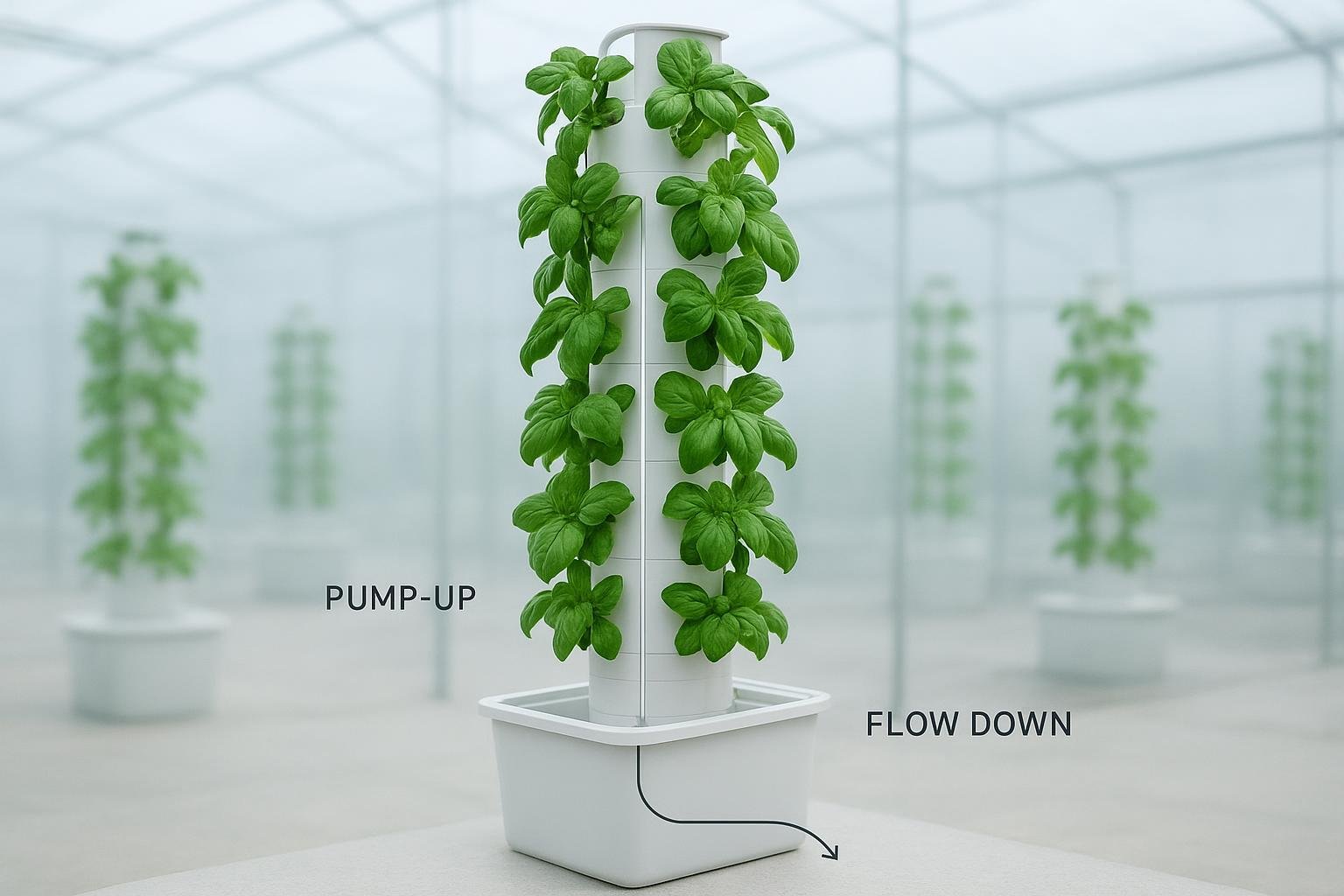
This remarkable efficiency improvement is rooted in the extreme control of the growing environment. Within the sealed vertical hydroponic unit, an artificial intelligence system adjusts the spectrum, intensity, and photoperiod of LED lighting in real time, maximizing photosynthetic efficiency to its theoretical peak, with a power density precise to 250 watts per square meter. Nutrient solution is precisely delivered through a circulation system at a flow rate of 2-4 liters per minute, achieving a water recycling rate of up to 95%, saving 90% of water compared to traditional irrigation. Environmental sensors continuously monitor temperature (deviation controlled within ±0.5°C), humidity (fluctuation range ±3%), and carbon dioxide concentration (maintained at 800-1200 ppm), shortening the crop growth cycle by an average of 40%. For example, the growth cycle of lettuce can be reduced from 60 days to 36 days. This means your production schedule will be as precise and predictable as industrial scheduling, completely eliminating the volatility and risks of relying on the weather.
Quality and consistency are key to winning the high-end market. Vertical hydroponics operates in a sterile or low-bacteria environment, reducing pesticide use by over 90%. The risk of microbial contamination in the produced crops is extremely low, meeting increasingly stringent food safety standards, such as China's GAP certification. The nutritional content of crops, such as vitamin C and antioxidants, can be targeted to increase by 15%-30% through spectral modulation. Consumers are willing to pay a premium of up to 200%-300% of the average market price for such clean, safe, and nutritionally controlled products. Referring to the success of the American company Plenty, its indoor vertical farm-produced vegetables, with their superior appearance and "extreme freshness" concept, have become favorites in high-end retail channels such as Whole Foods Market.
The value of vertical hydroponics in terms of supply chain and risk resistance is equally immeasurable. It relocates agricultural production from remote rural areas to urban suburbs and even city centers, reducing transportation distances from an average of 1500 kilometers to less than 50 kilometers. This not only reduces logistics costs by 60%, but also drastically shortens the time from harvest to shelf from 5-7 days to within 24 hours, and lowers the spoilage rate from 30%-40% in traditional supply chains to below 5%. In the face of extreme weather and geopolitical risks, a localized vertical farm serves as a stable food supply bulwark. The COVID-19 pandemic and extreme weather events have repeatedly demonstrated that decentralized, localized food production capabilities are crucial for ensuring community resilience.
In conclusion, investing in commercial vertical hydroponics systems essentially upgrades agriculture from a "resource-dependent" industry to a "technology-driven" one. It replaces the uncertain natural risks and fluctuating market prices of traditional agriculture with certain capital expenditures, predictable operating costs, and controllable production parameters. This is not merely purchasing equipment; it's investing in an efficient, stable, sustainable, and profitable future food production solution. While your competitors are still calculating yields per acre and weather probabilities, you are already using data dashboards to control the growth rate and nutrient concentration of each layer of crops—this is the strategic advantage that vertical agriculture offers.
Quality and consistency are key to winning the high-end market. Vertical hydroponics operates in a sterile or low-bacteria environment, reducing pesticide use by over 90%. The risk of microbial contamination in the produced crops is extremely low, meeting increasingly stringent food safety standards, such as China's GAP certification. The nutritional content of crops, such as vitamin C and antioxidants, can be targeted to increase by 15%-30% through spectral modulation. Consumers are willing to pay a premium of up to 200%-300% of the average market price for such clean, safe, and nutritionally controlled products. Referring to the success of the American company Plenty, its indoor vertical farm-produced vegetables, with their superior appearance and "extreme freshness" concept, have become favorites in high-end retail channels such as Whole Foods Market.
The value of vertical hydroponics in terms of supply chain and risk resistance is equally immeasurable. It relocates agricultural production from remote rural areas to urban suburbs and even city centers, reducing transportation distances from an average of 1500 kilometers to less than 50 kilometers. This not only reduces logistics costs by 60%, but also drastically shortens the time from harvest to shelf from 5-7 days to within 24 hours, and lowers the spoilage rate from 30%-40% in traditional supply chains to below 5%. In the face of extreme weather and geopolitical risks, a localized vertical farm serves as a stable food supply bulwark. The COVID-19 pandemic and extreme weather events have repeatedly demonstrated that decentralized, localized food production capabilities are crucial for ensuring community resilience.
In conclusion, investing in commercial vertical hydroponics systems essentially upgrades agriculture from a "resource-dependent" industry to a "technology-driven" one. It replaces the uncertain natural risks and fluctuating market prices of traditional agriculture with certain capital expenditures, predictable operating costs, and controllable production parameters. This is not merely purchasing equipment; it's investing in an efficient, stable, sustainable, and profitable future food production solution. While your competitors are still calculating yields per acre and weather probabilities, you are already using data dashboards to control the growth rate and nutrient concentration of each layer of crops—this is the strategic advantage that vertical agriculture offers.